Crossing the Chasm | High Level Overview and Key Takeaways for Startups
Crossing the Chasm by Geoffrey Moore #Review #BusinessBook
1/10/20269 min read
We recently read the startup classic Crossing the Chasm as a company. Which in start up world is the go to guide for finding market fit and traction once you have a viable product.
To save time later, I condensed the book into these notes—focusing on the actionable advice rather than a critique. Since as much as I wanted to believe I would remember everything I know in a few months that would no longer be the case.
I want to note - this isn’t a review of the book, while I have some reservations about certain sections, the roadmap for aligning a team toward a mainstream market is valuable, and has solid advice.
Here are my Chapter by Chapter notes
Chapter 1 High-Tech Marketing Illusion Review
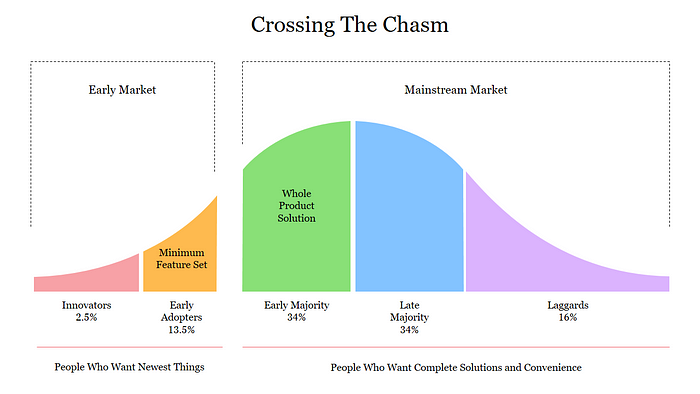
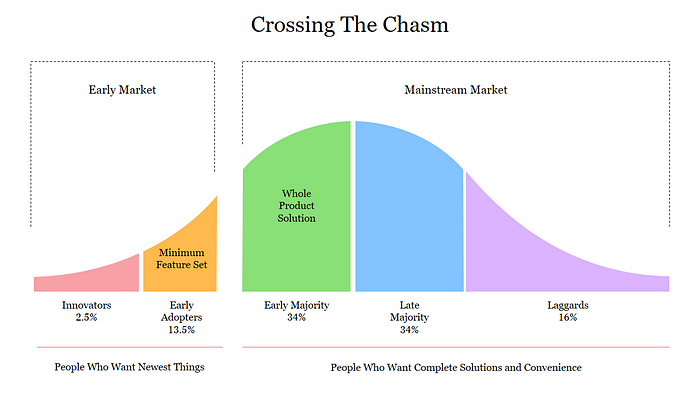
Innovators - like tech because it’s new and cool. Will seek out the tech. Willing to deal with Bugs
Early Adopters - Aren’t super tech focused but are smart and imaginative and can see how a product could give them a massive advantage
Early Majority - want the product to be proven. Read reviews, ask for recommendations. Typically rely on other early majority users for their recommendation
Late Majority - these are the skeptics. They are more cautious and will only adopt if something has become the standard and feel like they are being left behind
Laggards - resistant to new tech and will most likely never adopt the thing at all. (Do not try and sell to these people
The Chasm
Huge Gap between Early adopters and Early Majority as they want different things and need to be sold the product differently.
Early Adopters are looking for a radical breakthrough and are willing to piece some of it together themselves
The Early Majority - want a complete, proven and reliable solution
Chapter 2 - High Tech Marketing Enlightenment
First Principles
Marketing Strategies must change as you move from one customer group to the next
That approach that wins you in the early market will fail in the mainstream market
A Market/Group is buyers who can reference each other
Early Markets
Innovators - crucial for early feedback. Want to be the 1st to figure things out. Don’t typically have money or influence so want things cheap
Early Adopters (Visionaries) - This would be the 1st customers
Motivations - not afraid of risk, see new tech to achieve a strategic dream/ goal/project
How to sell to them - Sell them the dream. Less concerned with current features
Downside - Can be very demanding, if their project is unique difficult to make it usable for multiple companies
Need to figure out how to “productize” from any deliverables on their projects or pilots
Mainstream Markets
Pragmatists - Practical, risk-adverse and want evolution not a revolution
Motivations - need to see proven use cases and want to buy from established markets because it’s the safest choice
Buy/Sell - They want the “whole product” including training support and a stable vendor
Key trait - make decisions based on references from their peers
(I swear if I have to read the phrase catch-22 anymore I am going to lose it!)
Late Majority - the conservatives/Skeptics
I don’t think we need to focus on these people for our product. They just are behind in tech and will use what they have until they can’t
How to get in
Work with trusted parties as a value add on
The Chasm
Values of the Visionaries and Pragmatists are in direct opposition
Four fundamental values that alienate pragmatists
Visionaries lack respect for their colleague’s experience
Take greater interest in tech than their industry (defining the future)
Fail to acknowledge the importance of existing product infrastructure
Have little self-awareness of the impact of their disruptiveness
A reference from a visionary is seen as a red flag by a pragmatist
Lack of credible peer references between the two groups is a fundamental reason the chasm exists and is so difficult to cross
Chapter 3 - The D-Day Analogy
Explains crossing the chasm like D-Day… which feels a little weird to be but I get the analogy.
Primary task - identify the target Market segment that is small enough to to be dominated with limited resources
This is counter-intuitive as most small start ups are sales driven
Characteristics of a good target Niche
Big Enough to matter
Small enough to win
A good entry to other adjacent niches in the future
Four Step Process for Targeting a Market
Target the point of attack - looking for a specific type of pragmatic customer who has a compelling reason to buy
Assemble the Forces - you must create the “whole product”
Customers don’t buy your core product but a complete solution to their problem
Define the battle - who is your true competition
Define yourself in relation to them - you are the better more specific solution for this niche problem
Launch the invasion - concentrating all your sales and marketing efforts on the target segment
Goal is to get word of mouth references within that niche
3 Company Examples
Just illustrate the point of crossing the chasm
Not going to List them all here but it's good to read if you are not familiar with the examples
Chapter 4 - Target the Point of Attack
High Risk, Low Data decision
Lack traditional Market data and decision will be made on qualitative scenarios rather than quantitative data
Informed Intuition
Final choice will be a judgement call - go through his process and it will be “informed”
Target- Customer Characterizations
Creating detailed profiles or personas of potential customers
Don’t use vague descriptions - but a specific type of person in a specific role with a specific problem
Use case scenarios - for each person develop a “use-case”
Not a list of features but a story that describes or highlights critical problems
3-D printing example -
Better for everyone if you can create something custom to go with an existing product
Although even in the example I am not sold on the new technology - I guess I am not the target audience for that!
The Marketing Development Strategy Checklist
Target Customer - identifiable, single economic buyer who is accessible to your sales channel
Compelling Reason to Buy - economic pain of their problem is so severe that they are highly motivated to find a solution now
Whole Product - Can you realistically provide the entire solution - within a reasonable timeframe
Competition - who is the established market leader in this niche that you will have to displace
Partners and Allies - can you get the help you need from other companies to deliver the whole product
Distribution - do you have a sales channel that you can effectively reach and sell to this specific customer
Pricing - is the customer willing to pay a price that will support your business
Positioning - can you be seen as a credible and leading provider in this niche
Next Target - Does winning this niche set you up to attack an adjacent, larger market? (the bowling pin)
Scoring the Check List
Model works on a 1 - 5 Rating Scale
Target Market Selection Process
Develop a library of target customer scenarios
Appoint a subcommit to make the target selection
Number and publish the scenarios
Have each member privately rate the scenarios
Rank the order
Depending on outcome
Either Group agrees on beached segment
Cannot agree on a final few - give to 1 person to decide
No scenario survived
Chapter 5 - Assemble the invasion Forces
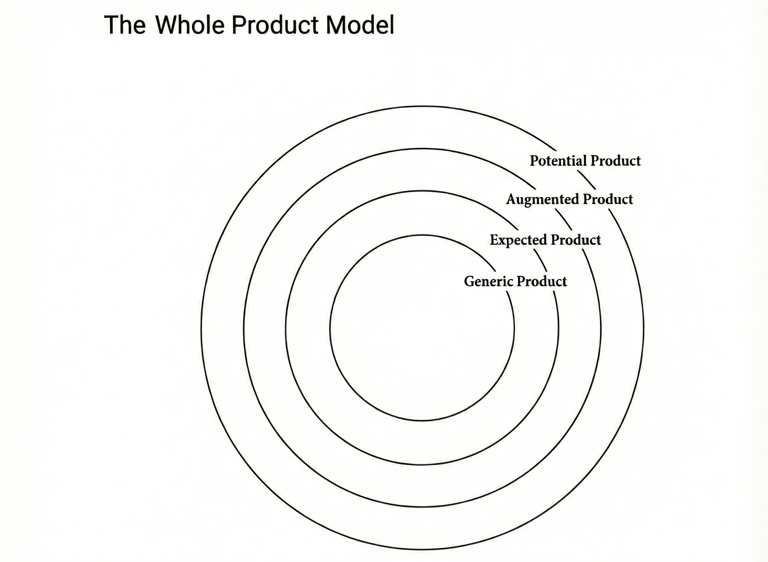
The Whole Product Model
Generic Product
This is what is shipped in the Box
Expected Product
This is what the customer thought they were buying, minimum configuration of product/services
Augmented product
Includes all the extras needed to create a complete frictionless solution
Potential Product
Represents the future potential and long-term vision for the product
Whole Product Planning
Goal identify and fill the gap between your generic product and the complete solution
Identify the Gaps
Create a list of everything a customer needs to get to their desired result
Highlight what your company DOES NOT provide
Find and Co-Opt Partners
Become the Whole Product Manager (orchestrate the entire ecosystem, not just focus on the core product but the complete customer experience)
The Simplified Whole Product Model
Inner circle - what your company commits to providing,
Outer circle - represents the whole product and expected product
Can be provided by partners and allies
Partners and Allies
Basically no startup can deliver the entire whole product on its own - as they don’t typically have the resources.
Target niche needs then form strategic partnerships to provide them
Tips on Whole Product Management
Use the doughnut diagram to define and then communicate the whole product
Shade in areas which you intend your company to take primary responsibility
Review the whole product to ensure it’s reduced to its minimal set
Review the whole product from each participant’s point of view
Make sure each vendor wins and no one gets an unfair share of the pie
Develop the whole produce relationship slowly, working from existing instances of cooperation towards a more formalized program
With Large partners work from the bottom up, with small ones from the top down
Once formalized relationships are in place, use them as openings for communication only
Don’t count on them to drive cooperation
If working with a very large partner, focus your energy on establishing relationships at the district sales level, if working with a small company be sensitive to their limited resources
Don’t be surprised to discover the most difficult partner to manage is your own company
Chapter 6 - Define the Battle
Creating the Competition
If there is competition then there is no market
Need something to point to that shows an alternative since pragmatists don’t like to buy until they can compare
Creating two competitors as Beacons
The Market alternative - the one they have been buying from for years
Product alternative - same disruptive innovation and gives credibility that it’s time to embrace new alternatives
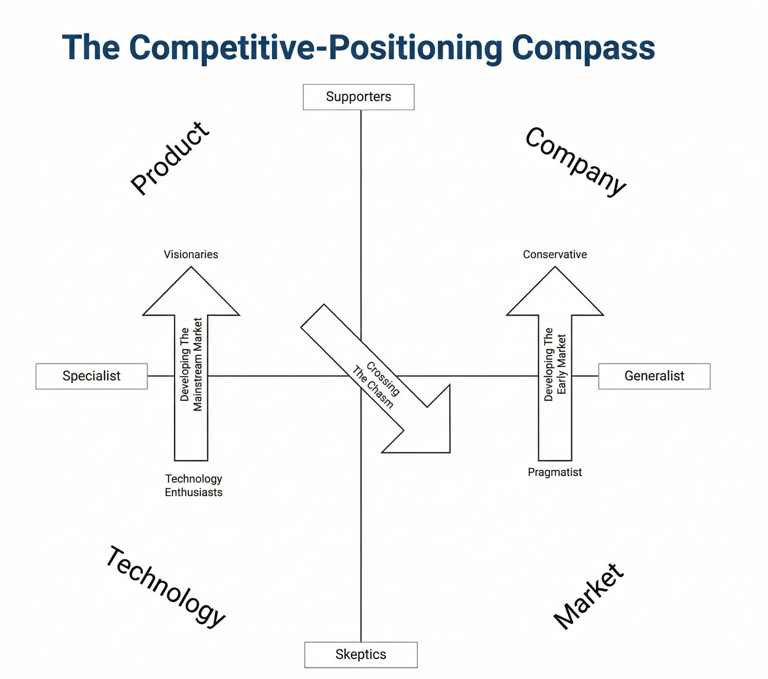
The Competitive- Positioning Compass
Have to move from the supportive environment of the visionaries back to the one of skepticism among the pragmatists
Left side is the early market - You win by your breakthrough tech/features
Rightside is mainstream market - win by proving category fit, references and whole product
Top - aim message at likely supports and avoid optimizing for Skeptics
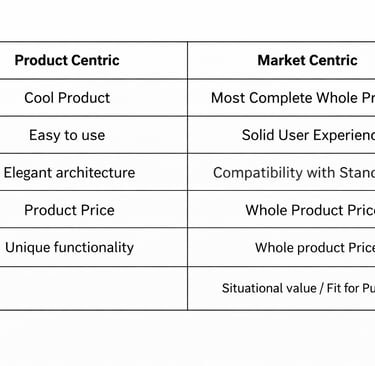
Shift Marketing focus from celebrating product centric values to market-centric ones
Positioning
Positioning is a noun, not a verb - best associated with a company or product
Is the largest influence on the buying decision
Serves as a shorthand
Exists in peoples heads, not in words
People are highly conservative about entertaining changes in positioning
The positioning Process
The Claim
Boil core message into a two-sentence format.
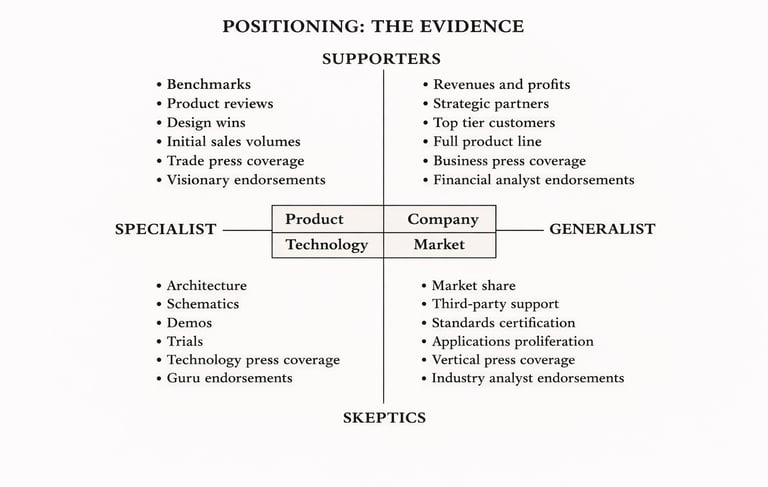
The evidence
You need proof -or your claim is meaningless
Communications
Figure out who you need to talk to - then get the right version to the right people in the right order
Feedback and Adjustment
Competition will try and poke holes in your argument - listen then fix any weaknesses
Does it pass the Elevator test
Basically can you explain your product or service in 90 seconds or less
Or as mentioned in several places - two-sentences
Shifting the Burden of Proof
In sum, to the pragmatist buyer, the most powerful evidence of leadership and likelihood of competitive victory is market share.
In the absence of definitive numbers here, pragmatists will look to the quality and number of partners and allies you have
Whole Product Launches
Moving from look at this how new product to look at this new market
Messaging typically consists of the description of the emerging new market anchored by a new approach to the problem
The Competitive Positioning Checklist
Focus on the competition who are trying to solve the same specific problem for your target customer
Define the real alternatives - frame the competition from your customer’s point of view
Simplify your competitive advantage into a clear, two-sentence elevator pitch
Back up your claims by delivering a high-quality "whole product" that solves the customer's entire problem, not just part of it.
Chapter 7 - Launch the Invasion
Customer-Oriented Distribution
Choose the sales channel based on target pragmatic customer need to feel confident and safe buying
Enterprise Execs - relationship marketing and solution selling
End Users - online and self service
Department Heads direct touch marketing, sales and service online
Engineers - gate keepers - online material to review when ready bring sales in
Small business owners/operators -
Distribution-Oriented Pricing
Pricing must be high enough to support the high cost of your chosen sales channel
Price and the sales channel must reinforce each other - premium price signals that the customer is buying a high-end solution
Recap -
Secure access to a customer-oriented distribution channel
Type of channel you select for long-term servicing is a function of the price point of the product
Price in a mainstream market carries a message
Remember that margins are a channel’s reward
Conclusion - Leaving the Chasm Behind
(it bothers me that he didn’t number this chapter)
The post chasm enterprise is bound by the commitments made by the pre-chasm enterprise.
Basically try to avoid making mistakes in the early phase
Financial
Moving from losing money to making money
People Effect
Pioneers vs Settlers - the people who helped get the company running might not be the same people to move to a main stream company
Have two Job temporary roles to fix the issues that arise from moving across the chasm
Compensation
Didn’t go to in depth but need to be mindful so that you don’t create division and reward the wrong behaviors