From Preferences to Norms: A Practical Guide to Team Communication
DISC Communication Styles & Leveraging Team Preferences
1/13/20263 min read


At our latest All Hands meeting, I gave a communication training workshop. This is the second year I have held it, and it’s become a vital way to ensure we open up the dialogue and make sure we are actually communicating—not just talking at each other.
More importantly, this workshop helps us reduce friction, speed up decision-making, and stop miscommunication before it becomes personal.
To anchor the discussion, I use DISC. Using an objective framework keeps the conversation factual and removes defensiveness. The goal isn’t to box people into personality types — it’s to give the team a shared language for understanding why communication breaks down.
For those unfamiliar, DISC is a behavior assessment tool that centers on four different personality traits: Dominance, Influence, Steadiness, and Conscientiousness.
Before the meeting, I had everyone take a free DISC assessment. ( I used this one -https://onlinediscprofile.com/free-disc-assessment/ ). Using an objective framework like this highlights the clear friction between different styles and helps give everyone a shared language to discuss differences.
The "Hot Topic": Email vs. Slack
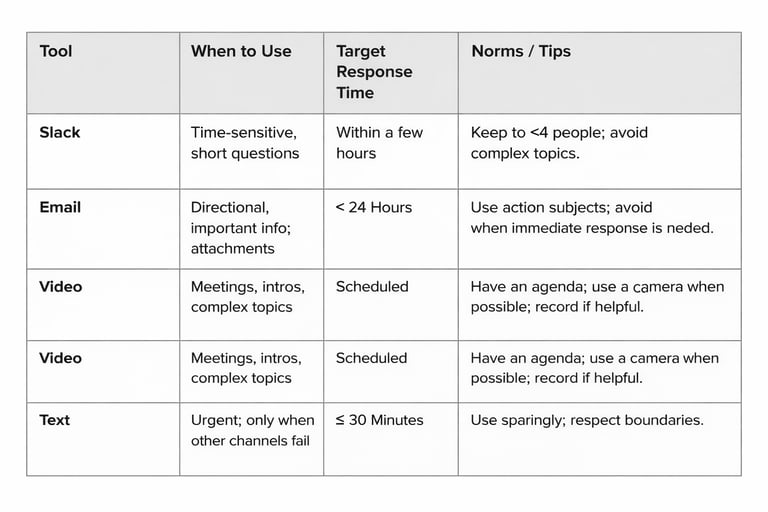
The most interesting part of the workshop happened when I put up a table discussing Tools and Response Times. This sparked an immediate debate: Email vs. Slack.
We went around the room and talked about preferences, and it was eye-opening for the team to see that not everyone used tools the way they did.
Half the team used their Email as their primary "To-Do List."
The other half used Slack as their "Source of Truth" to keep track of project links and communication threads.
We realized the friction wasn't just about preference; it was about role. Those in client-facing roles relied on email because you generally don't Slack with clients. Those in internal-facing roles didn’t typically email as it’s easier to work asynchronously through slack as there is not as much waiting on the back and forth. And part of that is checking notifications - if you are using one or the other you may not be checking one channel as frequently as the other.
The Solution: Defining Our Communication Norms
To solve this, we didn't just argue about apps; we created a Communication Agreement. We looked at every tool we use and asked the question: "Do we agree as a company on how this is used?"
Here is the framework we built:
Note: The "Text" row is crucial. We agreed that texting is the "break glass in case of emergency" tool, which protects everyone’s personal time.
My Personal Evolution: Adapting Your Style
One of the biggest takeaways I shared with the team is that no person is just one style. Being in business, or stepping into specific roles, challenges us to adapt.
I started my career as a straight C (The Analyst). I was as close to the outer edge of the chart as possible—highly analytical, cautious, and focused on accuracy.
However, over the last 8+ years, I have adapted. I am now a CSd.
Working with CEOs, Clients, and Vendors required me to add more Dominant characteristics to my communication.
While I am still focused on data and accuracy, I have had to become more decisive and results-driven. I now focus less on "being right" and more on: "What are the most important points we want to get across, and how can we ensure our actions line up?"
A Quick Guide to the 4 Styles
To communicate effectively, you first need to understand who you are talking to. Here is a cheat sheet I use:
D - The Initiator/Leader: Focused on results and speed. Wants facts, highlights, and clear next steps — minimal fluff
I - The Motivator/Promoter:Values enthusiasm, connection, and the big picture. Thinks emotionally and prefers vision over details.
S - The Supporter/Coordinator: Prioritizes stability and teamwork. Prefers step-by-step explanations and collaborative approaches.
C - The Analyst/Connector: Data-driven and cautious. Needs accuracy, context, and time to understand the “why” and “how.”
Understanding these differences doesn’t mean changing who you are — it means choosing how you communicate.
Try This With Your Team
I am sharing a quick template for you to use to help get this conversation started in your own company.
The Audit: Have your team take the free assessment
The Visual: Plot Names (or dots )to the corresponding spot on the DISC circle. So everyone can see the distribution
The Discussion: Use this as a starting point to discuss how you communicate.
Talk through the different styles and where friction naturally occurs
Ask which tools (email, Slack, phone) cause the most frustration
Discuss response-time expectations openly
It is amazing what you can uncover when you simply ask everyone how they prefer to work.